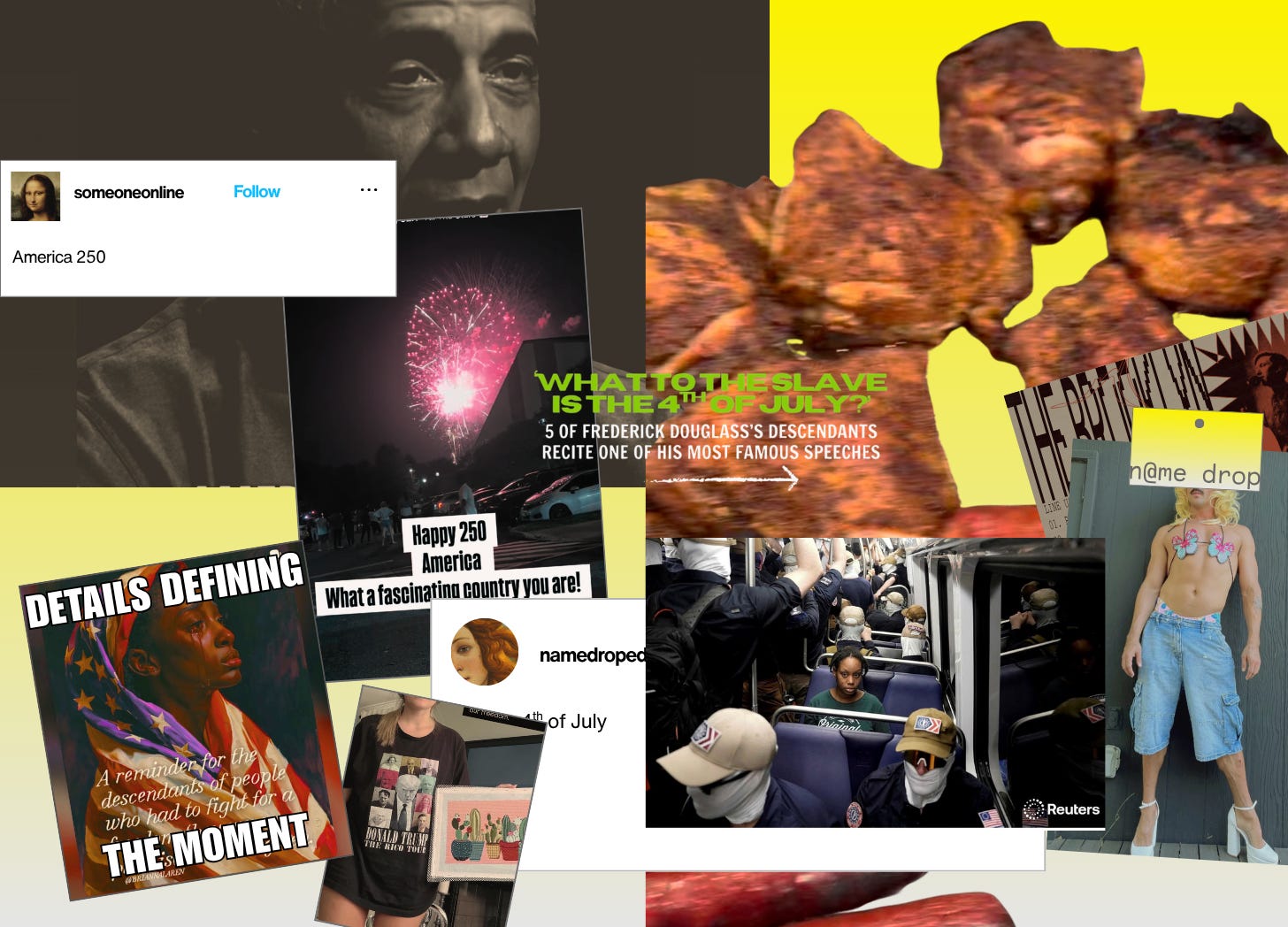
As I scrolled, I saw one of my favorite fitness instructors in drag, chunky heels, shorts, flower bikini top covering his nipples, wishing everyone a happy Fourth of July.
I saw images that looked like they came from the 1930s, Black figures dancing in red, white and blue. I saw a Black woman draped in the American flag, tears streaking down her face with the words, “A reminder for the descendants of people who had to fight for a freedom they were promised but not given.”
I saw white nationalists marching near the Capitol, then gathering into the Metro, surrounding a Black woman.
I saw fireworks lighting up the night sky.
I saw President Trump’s vision of America, military planes overhead, record-breaking fireworks, a big fair, everything oversized and opulent. He got what he wanted despite the mild rain. Big. Loud. Expensive. Spectacular.
I saw a young, blonde Gen Z feminist I met online wearing a shirt with Trump, Giuliani and others in what appeared to be mug shots saying “The RICO tour.” She added a caption saying she was celebrating the last time the justice system worked, happy Fourth of July with Lana Del Rey’s “National Anthem” song attached.
I saw people crocheting. I saw barbecue plates. Hamburgers. Hot dogs. The kind of summer food that makes you understand why people love a grill.
I saw a Ukrainian monument lit up in red, white and blue, posted with the hope that Americans, particularly JD Vance would remember Ukraine still sees and values this country’s support.
One series of posts starts with a boat flying an American flag. The next shows a boat with a Mexican flag. Then fireworks over the Brooklyn Bridge, Spanish music playing in the background.
I saw someone post a clip of President Obama talking about America as a country built through violence and subjugation, but also as a country that still holds something powerful and beautiful.
I saw a post of Frederick Douglass’ speech, of course. “What to the Slave Is the Fourth of July?” always comes back around this time of year. And it should. It is one of those texts that forces you to sit with the contradiction at the center of the holiday, a country celebrating liberation while denying it to so many people.
That is a lot to process.
And maybe that is what so many of us are doing on the Fourth of July now. Processing.
Processing pride. Processing grief. Processing belonging. Processing exclusion. Processing what this country has given us, what it has taken from us, and what it still asks of us.
It all feels like people saying, this is my story too.
That feels especially important right now, because we are living through a louder tug-of-war over the identity of the United States. You can hear it in political speeches. Some people talk about American exceptionalism. Some talk about immigrants and whether they belong. Some talk about patriotism versus nationalism. Some want a country that feels narrower. Others are insisting the story has always been wider than we were told.
But underneath all of it is the same question. Who am I in this story?
Because for many of us, this is home.
Even when America is painful, it is home. Even when we leave, it is home. Even when we are angry at it, disappointed by it, exhausted by it, it is still the place that shaped us. The place our children will inherit. The place we are trying to make sense of.
That is the strange emotional work of being American.
I have represented this country overseas as a U.S. diplomat. And I now poke at its imperfections as a reporter. Both are acts of patriotism, of love.
Both experiences remind me of how grossly and beautifully American I am.
Not because America is perfect. Not because it has always loved me back. But because this is the place where I learned how to be myself. This is the country whose language, contradictions, freedoms, failures and promises shaped me.
So on the Fourth of July, I find myself wanting to celebrate and process at the same time.
I want the fireworks. I want the barbecue. I want the music. I want the joy.
But I do not want my joy to require amnesia.
I want to acknowledge the parts that are beautiful and the parts that are painful. I want to be included without pretending exclusion never happened. I want to feel pride without surrendering honesty.
This processing is something I have to do almost every year. Sometimes I think I’ll be done, but each year I’m back, struggling to take it all in.
But then I’m reminded that this takes time. America is 250 years old and still figuring out who it is. Still processing.
Subscribe and Share
If this is the kind of stuff you want more of, subscribe. I'm going deeper on this. And if you know someone who should be paying attention to this, send it to them. Or maybe you just want to make a one-time donation to keep this Substack alive.
Follow me on TikTok!
Follow me on Instagram too!
And here is my LinkedIn.
Order a signed copy of my sci-fi novel The Herd- When Democracy Falls.
And remember,…